Some details in the Venezia 70 Future Reloaded(2013) exhibit some interesting points.

Firstly, the curriculum depicted in the film illustrates how Chinese film scholars evaluate Western classics. The appreciation list features Triumph of the Will(1935), The Sound of Music(1965), Forrest Gump(1994), and Transformers(2007), which includes documentaries, commercial films, and musicals. For Chinese filmmakers, these films represent the essential canon that should be examined for their symbolic content and filmmaking techniques.
Secondly, the emphasis on facial close-ups and celebrities in which Demi Moore is involved echoes her film, The Substance (2024). Demi Moore expresses in her autobiography her significant anxiety about her aging appearance. This ties in with Demi Moore’s role in the film, where her character, Elisabeth Sparkle, a movie star, confronts the drastic changes brought on by “the substance” as her looks deteriorate. She nervously navigates the struggles between maintaining youth and beauty versus succumbing to accelerated aging and a monstrous transformation. I wonder if Todd Solondz had read Demi Moore’s autobiography before naming her the primary celebrity of focus.
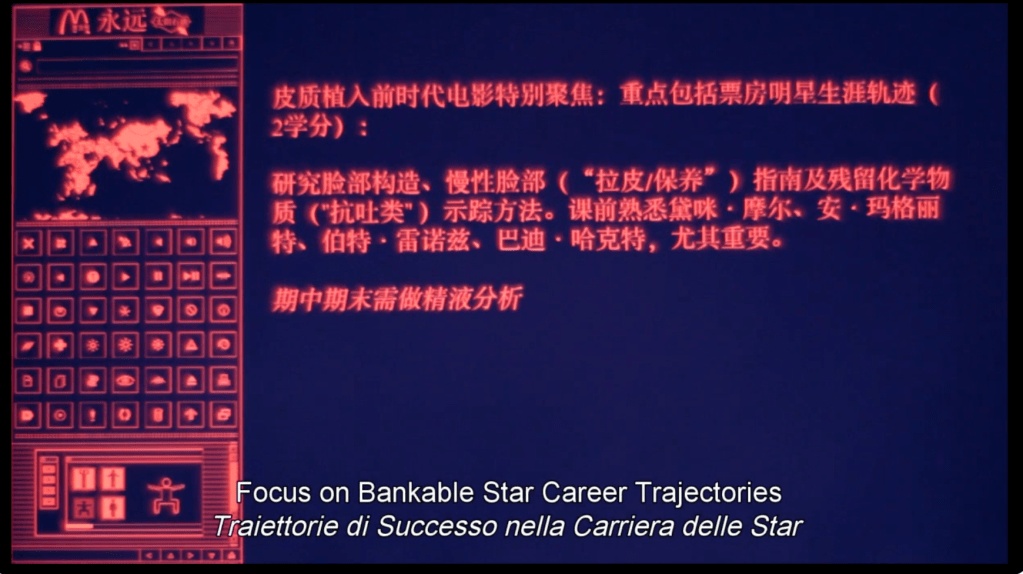
Thirdly, the distribution of credits shows a clear tendency to emphasize technology and symbolism, hence three credits for the film technology appreciation course, two for the study star course, and only one for the discussion of film and humanitarianism course.
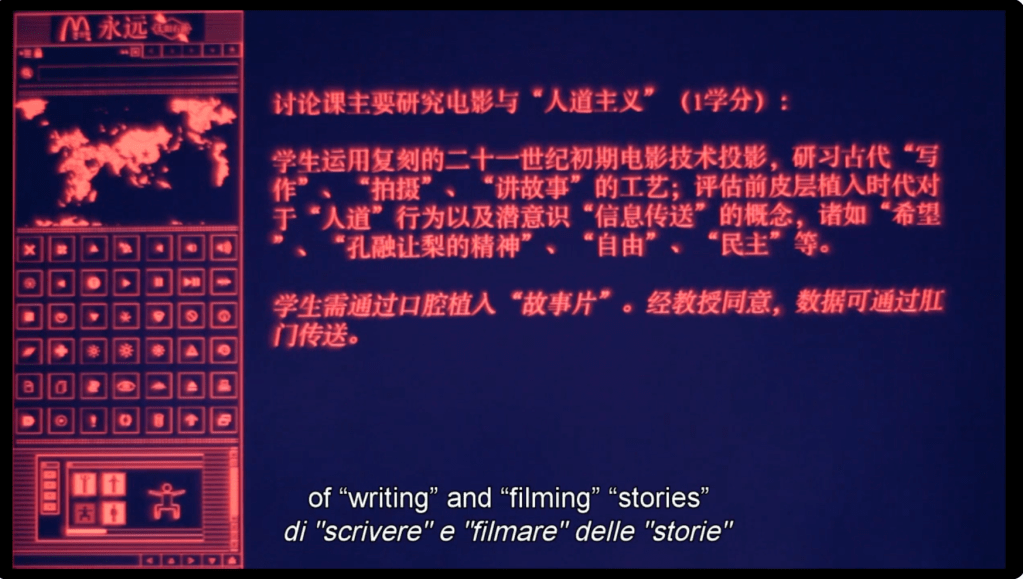
Last but not least, the methods of data transmission are also very interesting: students are required to intra- contex download, make a semen analysis, implant features orally, or anal penetration. Do future film students still need to watch movies with their eyes? Or has cinema evolved into a whole-sensory experience? All the data from a film could be stored on a chip implanted in the brain’s cerebral cortex. All the scenes from the film could then be recognized directly through brain waves. Such a posthumanist film curriculum.
Work Cited:
 shuqin Yan
Leave a comment